
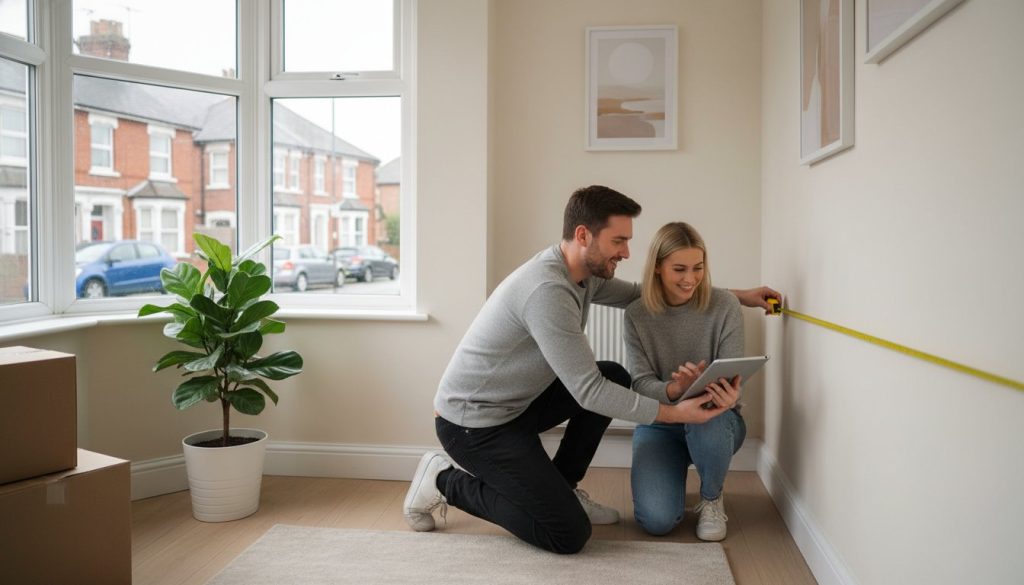
Last Saturday, a homeowner in Manchester watched their £1,400 investment return to the warehouse because the hallway was just 15mm too narrow. It’s a heartbreaking scenario, but with 1 in 10 large furniture deliveries in the UK facing access issues, it’s more common than you might think. You’ve likely spent hours browsing the stylish ranges at Living Chic or exploring seating options at Sofatey, so the fear of a delivery day disaster is completely understandable.
Mastering how to measure for a new sofa involves more than just checking if it fits against the wall; it requires a strategic look at every doorway, corner, and radiator along the path. We’ll help you gain total confidence by providing a foolproof list of dimensions and explaining the vital difference between overall width and seating width. This guide covers everything from entry point clearances to maintaining a balanced room flow, ensuring your new furniture arrives and fits exactly as planned.
The Essential Sofa Dimensions: Understanding the Key Numbers
Choosing a stylish new centrepiece for your lounge is an exciting way to transform your home. However, the success of your purchase relies on precision. Before you fall in love with a velvet three-seater, you must master the technicalities of how to measure for a new sofa. Getting these figures wrong leads to delivery day disasters where furniture won’t fit through the door or overwhelms your living space. At Living Chic, we believe quality furniture should fit your lifestyle and your floor plan perfectly.
Width, Height, and Depth Explained
Total width is the most deceptive figure you’ll encounter. Manufacturers measure from the outermost points, which usually means the edge of one armrest to the other. In compact UK living rooms, wide, flared arms can add 25cm to 40cm of footprint without providing extra seating. Always compare the total width against your available wall space, leaving at least 10cm of breathing room on either side for a balanced look. You can explore different types of sofas to see how various arm styles impact these total dimensions.
Height measurements require two distinct checks. Frame height refers to the solid structure, while cushion height includes the top of the backrest. If you plan to place your sofa under a window or a low shelf, the frame height is your limit. External depth is equally vital; it determines how far the piece protrudes into the room. A standard sofa depth is roughly 90cm, but oversized “cuddle” chairs can reach 120cm, potentially blocking walkways or doorways. Ensure you have a clear path of at least 60cm around the furniture for easy movement.
The Crucial Diagonal Depth Measurement
Diagonal depth is the secret number that determines if your sofa actually enters your home. To find this, measure from the top back corner of the frame to the bottom front corner. This figure represents the sofa’s narrowest profile when tilted. If this number is larger than the width of your narrowest door frame, the sofa won’t pass through. Most standard UK internal doors are 76cm wide, so a diagonal depth of 70cm or less is generally safe for delivery.
Many modern designs feature removable legs. Removing these can shave 10cm to 15cm off the height, making tight corners much easier to navigate. Always check the “Packaged Dimensions” on our Living Chic product listings. These numbers tell you the size of the box, which is often significantly larger than the sofa itself due to protective padding. If you are also updating your outdoor space, our sister site Garden Chic offers a range of garden furniture with detailed size guides to help you plan your patio with the same level of accuracy.
- Total Width: Measure armrest to armrest.
- Total Height: Measure from the floor to the highest point of the cushions.
- Diagonal Depth: Measure from the top back to the bottom front.
- Packaged Size: Check for box dimensions to ensure hallway clearance.
Accurate numbers are the foundation of a beautiful home. By understanding these key metrics, you ensure your new investment looks as good in your room as it does in the showroom. Taking ten minutes to double-check your hallway and door widths now will save hours of frustration later.
Measuring Your Living Space: Planning the Perfect Layout
Finding the right spot requires more than just an empty wall. You’ve got to consider the physical footprint and the invisible boundaries that keep a room functional. When learning how to measure for a new sofa, always start with the fixed elements. UK skirting boards typically add 15mm to 25mm to a wall’s depth, while a standard radiator protrudes roughly 100mm. If you don’t account for these, your sofa will sit awkwardly away from the wall, eating into your floor space and potentially blocking heat circulation.
Try the “Tape Trick” to see the future. Use low-tack masking tape to outline the sofa’s exact length and depth on your floor. This 2D representation helps you visualise the “walking room.” You need at least 90cm of clearance for main walkways to avoid a cramped feel. Don’t forget about the visual weight. A bulky Chesterfield might look stunning in a room with a 3m ceiling, but it can overwhelm a modern flat with a standard 2.4m height. Look for slim legs and lower backs if your ceilings are on the lower side to maintain an airy, chic atmosphere.
The Newspaper Template Method
Lay down old newspapers or cardboard sheets to match the sofa’s footprint exactly. This allows you to physically test your daily routine. Can you still open the sideboard doors fully? Is there a clear path to the window? Leave a minimum of 30cm to 45cm between the sofa and your coffee table. This gap provides enough legroom while keeping your drinks within easy reach. If you’re refreshing your entire room, our stylish indoor furniture collection offers pieces designed to fit various UK floor plans beautifully.
Accounting for Architectural Obstacles
Architectural quirks often dictate where furniture can go. Measure the distance from the wall to the edge of your fireplace hearth; you’ll want at least 30cm of clearance for safety and aesthetics. In attic conversions or older cottages, sloped ceilings are a common hurdle. Measure the height at the lowest point where the sofa’s back will sit to ensure it doesn’t hit the pitch. Finally, check for floor-level obstructions. A floor socket or a heating vent located directly under a heavy sofa frame can be a fire hazard or block necessary airflow. Knowing how to measure for a new sofa means looking at the floor, the walls, and the ceiling simultaneously.
The Delivery Audit: Will It Fit Through the Door?
Your delivery audit begins the moment the van pulls up at the kerbside. It’s a common mistake to focus only on the living room floor plan while forgetting the three or four doors the furniture must pass through first. When learning how to measure for a new sofa, you must map the entire journey from the street to the final cushion placement. 95% of delivery failures in the UK occur at the first internal 90-degree turn or due to a narrow Victorian hallway. Don’t let your dream purchase end up back on the van because of a missed centimetre.
The 90-degree turn test is your most vital tool. If your hallway requires the sofa to pivot around a corner, the sofa’s height must be less than the hallway’s width. For example, if your hallway is 85cm wide, a sofa with a height of 90cm won’t make that turn unless it can be tipped onto its back or has removable feet. Use a piece of string or a cardboard template to “walk” the route. This physical check reveals exactly where the bulk of the frame will snag on door handles or corners.
External and Internal Access Points
Start at the very beginning of the path. Measure the height and width of your front door frame between the internal door stops. Standard UK door heights are usually 1981mm, but older cottages can be significantly shorter. If you have a rear-access delivery through a garden gate, check the clearance between the gate posts and any overhanging trees or porch roofs. These external dimensions dictate the maximum size of the box or frame before any unpacking begins.
For apartment dwellers, the communal lift is the primary bottleneck. A standard UK passenger lift often measures 210cm deep and 90cm wide. If your chosen sofa exceeds these dimensions, check the stairwell clearance instead. Measure the width of the stairs at their narrowest point, usually where the handrail protrudes. If the staircase has a landing, ensure the depth of that landing is greater than the longest side of your sofa to allow for a vertical lift.
Common Delivery Obstacles in UK Homes
Fixed banisters and radiators are the most frequent culprits for delivery day disasters. A radiator can reduce a hallway’s effective width by 15cm, which is often the difference between a smooth delivery and a stuck sofa. Low-hanging pendant lights and decorative coving also pose risks. Ensure you have at least 10cm of “wiggle room” beyond the sofa’s dimensions to account for the delivery team’s hands and the protective packaging.
If your measurements suggest a tight squeeze, consider furniture designed for tricky spaces. Browse our collection of modular sofas or designs featuring “bolt-on” arms. These clever pieces arrive in smaller sections, making them much easier to manoeuvre through narrow 75cm door frames. Understanding how to measure for a new sofa involves identifying these “squeeze points” early, so you can choose a style that fits your home’s unique architecture without compromising on comfort.
Specific Sofa Styles: Measuring for Corners and Recliners
Standard measurements provide a solid foundation, but specialised furniture requires a more detailed approach. Whether you’re eyeing a sprawling corner unit or a high-tech electric recliner, the physical footprint changes depending on how the piece is used. Understanding how to measure for a new sofa with moving parts or complex shapes prevents costly delivery day mistakes and ensures your room remains functional.
Corner and L-Shaped Sofa Logistics
Corner sofas are the ultimate choice for family lounging, but they demand precise spatial planning. You must decide between a Left Hand Facing (LHF) or Right Hand Facing (RHF) orientation. To determine this, stand at the front of the sofa; the “hand” refers to the side where the shorter “L” section sits. A typical 3-seater corner unit often measures 250cm by 200cm. You need to verify that the return section doesn’t block primary walkways or radiator heat flow.
- Measure both sides: Record the “long” and “short” lengths separately to ensure the unit fits the specific corner of your room.
- Check delivery splits: Most large corner units arrive in two or three sections. This makes navigating narrow UK hallways significantly easier.
- Modular flexibility: Modular sofas arrive as individual units, often 80cm to 100cm wide. Measuring these individual pieces ensures they pass through your front door before they’re clipped together.
The Recliner Clearance Rule
When you’re learning how to measure for a new sofa that reclines, depth is your most critical metric. A standard manual recliner often requires 15cm to 25cm of “pitch” space behind the headrest to lean back fully. If space is tight, look for “Wall-Hugger” models. These specialised mechanisms slide forward as they tilt, requiring as little as 5cm of rear clearance. You also need to account for the front footrest. This typically adds 50cm to 60cm to the total depth when extended.
- Power access: Electric recliners need to be within 1.5 metres of a 240V socket.
- Cable safety: Ensure wires are tucked away to prevent trip hazards in high-traffic areas.
- Sofa bed extension: A typical two-seater sofa bed extends to roughly 230cm from the back wall when the frame is out. Always leave a 40cm perimeter around the bed to allow guests to move freely.
If you’re looking to extend your stylish aesthetic from the lounge to the terrace, our sister site Garden Chic offers fantastic seating solutions for patios and decks. For those planning a complete garden overhaul, including storage for your outdoor cushions, visit Simply Log Cabins for premium garden buildings.
Ready to transform your living room with a piece that fits perfectly? Shop our collection of stylish sofas and armchairs today.
Finalising Your Choice with Living Chic
You’ve mastered how to measure for a new sofa, so now it’s time to select a piece that brings your vision to life. At Living Chic, we remove the uncertainty from the buying process. Our detailed product descriptions provide exact dimensions for width, depth, and height, alongside critical seat measurements. Industry data suggests that 92% of furniture return requests in the UK are due to sizing errors or access issues. We combat this by providing granular data on every listing. Choosing high-quality Living Room Furniture ensures your investment lasts for years while fitting your space perfectly from day one.
- Precise dimensions for every product to prevent entry-way mishaps.
- Direct access to our support team for pre-purchase dimension verification.
- A curated selection of styles that balance modern trends with timeless comfort.
- Detailed assembly guides to help you plan the final installation.
Why Quality and Scale Matter
A sofa acts as the anchor for your entire room. If the scale is off, the whole aesthetic fails. We focus on an “aspirational yet accessible” approach, meaning you get designer looks at competitive prices. Our experts attend at least 4 major international trade fairs each year to source pieces that fit standard UK home layouts. Browse our latest collection of Sofas and Armchairs to find designs that maximise seating without sacrificing floor space. We help you achieve that elusive balance between deep-seated comfort and architectural proportion; for those seeking world-class inspiration, you can discover Kartell Singapore Flagship Store by Lifestorey to see how iconic designs are showcased internationally.
Extending Your Style Outdoors
Your living space doesn’t end at the back door. If you want to organise your patio or terrace, explore our extensive range at Garden Chic. We help you maintain a consistent design language from your interior lounge to your outdoor seating area. Our collaborative team provides bespoke advice on furniture sizing, ensuring you understand how to measure for a new sofa whether it’s for a conservatory or a garden deck. With over 15 years of experience in the home and garden sector, we’re here to ensure your furniture choices are stylish, durable, and, above all, the right size for your lifestyle.
Ready to transform your home? Contact our customer support team today if you need a second pair of eyes on your measurements. We’re here to help you get it right the first time.
Ready to Transform Your Living Room with Confidence
Finding the right fit doesn’t have to be a guessing game. Now that you’ve mastered how to measure for a new sofa, you’re equipped to handle tight hallways and tricky corner layouts. Remember to double-check those door widths and allow at least 10cm of breathing room around recliners or walkways. These simple steps ensure your stylish new piece arrives and fits exactly as you imagined.
At Living Chic, we’ve spent over 15 years helping UK homeowners curate beautiful spaces. Our expert customer care team is available to provide bespoke sizing advice if you’re feeling unsure about a specific model. We attend major European trade exhibitions annually to source the latest 2024 trends, combining this expertise with competitive prices on premium brands. It’s about more than just furniture; it’s about creating a home you love coming back to every day.
Find your perfectly-sized sofa in our Living Room collection
Your dream home is just a few clicks and a measuring tape away. We’re here to help you every step of the way.
Frequently Asked Questions
How much space should I leave between my sofa and the wall?
You should aim to leave a gap of 5 to 10 centimetres between your sofa and the wall. This small space prevents the fabric from rubbing against the plaster and allows air to circulate, which stops moisture build-up. If you’ve chosen a recliner, you’ll need a larger clearance of 15 to 30 centimetres depending on the specific mechanism to ensure it operates smoothly without hitting the wall.
Can I fit a 3-seater sofa through a standard UK door?
Most 3-seater sofas fit through a standard UK internal door width of 76 centimetres if you angle them correctly during delivery. You must measure the narrowest point of your doorway, including the door frame and any protruding handles. If the sofa height is less than the door width, you can often slide it through on its side. If you’re also updating your outdoor space, our Garden Chic range offers stylish sets designed for easy garden access.
What is the standard depth of a comfortable sofa?
A standard comfortable sofa depth typically ranges between 90 and 100 centimetres. For those who prefer to sit upright, a depth of 90 centimetres is ideal for back support. If you like to lounge or tuck your legs up, look for a deeper model measuring 105 centimetres or more. This ensures your thighs are fully supported while you relax in your living room.
How do I measure for a corner sofa to ensure the orientation is correct?
To ensure the correct orientation, stand in the spot where the sofa will go and decide if the “L” shape should extend to your left or right. When you learn how to measure for a new sofa, you must record the length of both walls to avoid blocking doorways. A left-hand sofa has the shorter section on the left as you face it; always double-check the manufacturer’s diagram at Living Chic before making your final selection.
Do sofa measurements include the legs?
Yes, standard sofa height and depth measurements almost always include the legs in the total dimensions. If the legs are removable, the retailer often provides a “bolt-on” height and a “packaged” height for delivery purposes. This is crucial for access; removing 15-centimetre legs can make the difference between a sofa fitting through a tight hallway or being sent back to the warehouse.
What should I do if my hallway is too narrow for a standard sofa delivery?
Opt for a modular design or a “sofa in a box” if your hallway is narrower than 75 centimetres. These clever pieces arrive in smaller sections that fit easily through tight spaces and can be assembled in the room. You can also look for models with removable arms or low-profile backs. If you’re worried about indoor space, consider a stylish log cabin from Simply Log Cabins to create a spacious outdoor lounge instead.
Is it better to measure in centimetres or inches for furniture?
It’s best to use centimetres because 95% of UK furniture retailers use the metric system for their official specifications. Centimetres provide a higher level of precision than inches, reducing the risk of a 2-centimetre error that could prevent a perfect fit. Always use a metal tape measure for accuracy, as fabric tapes can stretch over time and give you a false reading.
How do I measure for a sofa bed to ensure it can open fully?
You need to measure the total depth of the room to accommodate a fully extended length of 210 to 230 centimetres. Clear at least 40 centimetres of additional walking space around the foot of the bed so guests can move around safely. Understanding how to measure for a new sofa bed involves checking the arc of the mechanism to ensure it doesn’t hit coffee tables, radiators, or other furniture when opened.