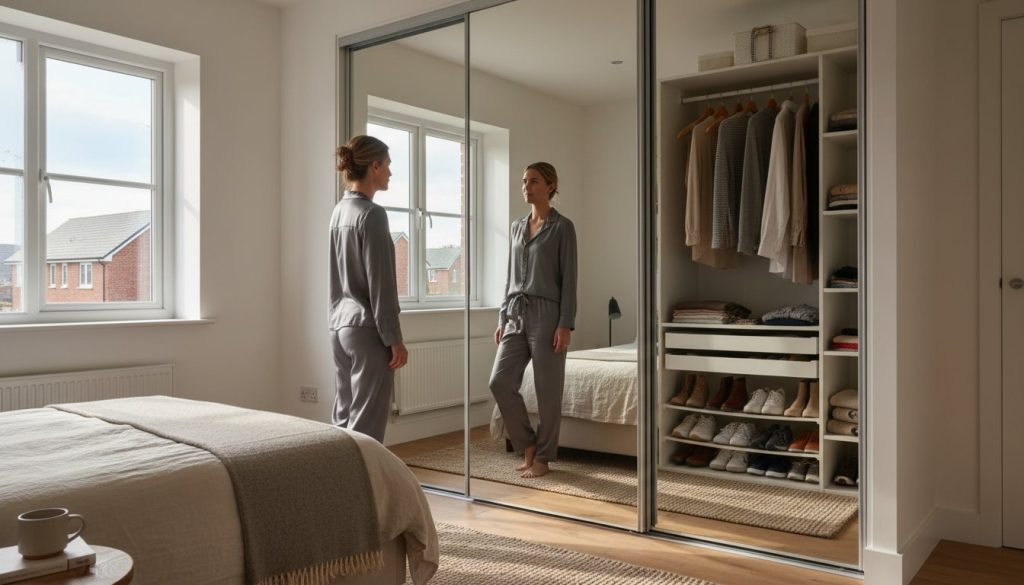
Choosing a wardrobe with sliding doors and mirror transforms a cramped bedroom into an airy sanctuary. Traditional wardrobes require a significant amount of floor space just to open the doors; usually around 50cm to 60cm of clearance is necessary. By contrast, a sliding mechanism operates on a track, requiring zero clearance in front of the unit. This design choice is vital for modern UK homes where floor space is often at a premium. Looking back at the history of furniture , storage has evolved from heavy, static chests to these sleek, multi-functional systems that prioritise efficiency and style.
To better understand how these space-saving designs function in a real-world setting, watch this helpful video:
To better understand this concept, watch this helpful video:
VIDEO
Mirrored surfaces act as passive light sources. In the UK, where natural light can be scarce during winter months, a full-length mirror bounces light from windows into the darkest corners of the room. This effect doesn’t just brighten the space; it creates a psychological sense of openness. High-quality mirrored panels can make a 12-square-metre room feel like it has doubled in size through simple visual trickery. It’s a practical way to achieve a high-end look without the cost of a full renovation.
Sliding doors are particularly effective in narrow hallways or alcoves. Because the doors don’t protrude, you can place your bed or other home furniture much closer to the wardrobe than you could with a hinged alternative. This flexibility allows for a more creative room layout, especially in Victorian terraces or compact city apartments.
Solving the Small Bedroom Dilemma
For the best results, position your wardrobe opposite or adjacent to a window. This placement catches the morning light, distributing it across the room to create a vibrant atmosphere. In modern apartment living, where every centimetre counts, sliding doors eliminate the “clutter-trap” of open doors blocking walkways. A reflective environment promotes a calm, organised feeling, helping you start your day in a tidy, bright space.
Aesthetic Versatility Across Interior Styles
A wardrobe with sliding doors and mirror fits seamlessly into various British decor styles. Whether your home is minimalist, industrial, or traditional, the glass finish adds a touch of sophistication. You can use these reflective surfaces to highlight other design features, such as a statement rug or a designer chair. Choosing floor-to-ceiling glass panels instantly creates that “boutique hotel” feel, bringing a sense of luxury and quality to your everyday living space.
The visual impact of a wardrobe with sliding doors and mirror extends far beyond simple storage. It serves as a large-scale design feature that defines the room’s character. Modern frames typically utilise lightweight aluminium for a sleek, industrial edge or wood-effect finishes to bring organic warmth to a space. Aluminium frames provide structural rigidity for taller doors, often reaching heights of 240cm, while remaining effortless to glide. For those seeking a minimalist sanctuary, frameless designs offer a continuous glass surface that eliminates visual clutter and creates a high-end, bespoke appearance.
Selecting the right configuration depends largely on your available wall width. Standard 2-door models usually span 120cm to 180cm, making them ideal for guest rooms or smaller masters. If you have a wall wider than 250cm, a 3-door or 4-door setup provides better accessibility to internal compartments. Beyond the frames, you must decide between full-mirror fronts and split-panel designs. Full mirrors instantly add depth and light , which is particularly effective in North-facing rooms that receive less natural sunlight. High-gloss panels paired with a central mirror strip offer a balanced look, breaking up the reflection whilst maintaining a contemporary feel.
Understanding Mirror Tints: Clear, Grey, and Bronze
Standard clear mirrors are the most popular choice for functional dressing areas because they provide 100% colour accuracy and maximum light bounce. However, tinted options are gaining traction in premium home furniture collections. Grey tinted mirrors offer a moody, smoked aesthetic that reduces glare and suits masculine or ultra-modern decor. Bronze mirrors provide a warmer, sepia-toned reflection. These are perfect for adding a touch of vintage luxury and work beautifully alongside gold or brass hardware.
Frame Colours to Complement Your Decor
The frame colour acts as the “outline” for your wardrobe and should coordinate with your existing furniture or architectural details. Consider these popular options:
White frames: These create a seamless look against light-coloured walls, making the unit feel built-in and less bulky.Black or Charcoal: Perfect for a “Crittall-style” statement, these frames provide a sharp contrast that anchors the room.Oak and Walnut: These finishes provide a grounded, traditional appearance that pairs well with soft textiles and carpets.
Choosing the right finish ensures your wardrobe with sliding doors and mirror remains a timeless addition to your home. If you need help matching a specific finish to your current bedroom set, feel free to get in touch with our team for expert advice.
Choosing a wardrobe with sliding doors and mirror involves looking beyond the aesthetic. While the evolution of the armoire has led to sleek, modern designs, the internal mechanics determine how long your furniture remains functional. High-quality ball-bearing rollers are the gold standard for these systems. These components allow heavy mirrored panels to glide with a whisper-quiet operation, reducing friction that can lead to premature wear. Cheap plastic runners often fail within 24 months, whereas steel-encased ball bearings are designed for thousands of cycles.
Safety is a non-negotiable factor when dealing with large glass surfaces. Always verify that the mirrors use safety-backed glass, which meets BS EN 12600 standards in the UK. This shatterproof backing ensures that if a high-impact accident occurs, the glass stays adhered to the film rather than breaking into dangerous shards. Regarding dimensions, a standard 60cm depth is ideal for hanging bulky coats and suits without the sleeves catching on the doors. If you’re working with a narrow corridor, slimline 45cm options are available, though these usually require side-on hanging rails.
Track Systems and Floor Levelling
The choice between top-hung and bottom-rolling systems impacts both the feel and the installation process. Top-hung doors create a floating appearance with no visible floor track, though they require a very sturdy wardrobe frame to support the weight. Bottom-rolling systems are more common in UK homes because they distribute the weight across the floor, making them exceptionally stable over time.
Adjustable Rollers: Many older UK properties have floors that aren’t perfectly level. Look for systems with 10mm to 15mm of vertical adjustment to ensure the doors sit flush against the side panels.Dust Strips: These vertical brushes sit on the edge of the door frames. They seal the gap between the doors to keep your clothes pristine and free from dust.Track Material: Aluminium tracks offer superior longevity and a smoother glide compared to plastic alternatives.
Maintenance for Long-Lasting Performance
A wardrobe with sliding doors and mirror requires minimal but consistent care to stay in peak condition. The tracks are the most vulnerable area; they naturally collect carpet lint and pet hair which can clog the rollers. Vacuuming the bottom track every 14 days with a crevice tool prevents debris buildup. For the mirrors, avoid ammonia-based cleaners which can damage the silvering over time. Instead, use a damp microfibre cloth followed by a dry one to achieve a streak-free finish.
Soft-close technology catches the door during the final 5cm of travel, gently guiding it home to prevent slams and protect the mirrored surface. This mechanism is essential for households with children, as it prevents trapped fingers and reduces the vibration sent through the glass panels. For more inspiration on styling your bedroom, explore our range of home furniture to find the perfect match for your space.
Precision is the foundation of a successful bedroom transformation. Getting your dimensions right ensures your new furniture fits seamlessly into your room without leaving awkward gaps or blocking walkways. Accuracy is particularly vital for a wardrobe with sliding doors and mirror because the sliding tracks require a level base and parallel sides to operate smoothly. If the frame is even slightly skewed, the doors may drift open or jam over time.
Start by measuring the height in three different places: the left side, the centre, and the right side. UK floors are rarely perfectly level, especially in older properties. If you find a variation of more than 5mm across the width, you’ll need to use packers or a floor plinth to create a level surface for the bottom track. Follow the same logic for the width by measuring at the top, middle, and bottom. Walls often lean outwards or inwards; a 10mm discrepancy can create visible gaps between the door and the wall that spoil the sleek aesthetic.
Account for architectural features that might obstruct the fit. Most UK homes feature skirting boards between 100mm and 150mm high and decorative coving at the ceiling. You must decide whether to remove these sections so the wardrobe sits flush against the wall or build a sub-frame to sit in front of them. Always measure the depth in multiple spots too. A standard wardrobe with sliding doors and mirror requires at least 600mm of depth to allow clothes to hang freely without touching the glass panels.
The Golden Rules of Wardrobe Measuring
Always measure in three places to identify wall lean. A 1% tilt over a 2-metre height creates a 20mm gap, which is enough to prevent the doors from closing flush. Ensure there’s enough clearance for internal drawers to open fully. Sliding doors usually occupy 80mm of internal depth, so your drawers must be recessed far enough to clear the track. Finally, check your access routes. Large mirror panels can be 220cm tall and heavy; they need to clear your stairs and doorways before they reach the bedroom.
Customising the Interior Layout
Plan your storage based on your actual clothing collection. Use double hanging rails for shirts and trousers to maximise vertical space; this usually requires 100cm of height per rail. Long-drop space for coats or dresses needs at least 160cm. Adjustable shelving is a smart choice because it lets you adapt the space as your storage needs evolve. Adding internal battery-powered LED lighting is a practical touch that makes finding outfits easier whilst the room is dim, without the need for complex electrical wiring.
If you’re unsure about how to measure your specific space or need advice on internal configurations, contact our helpful team for expert advice today.
A wardrobe with sliding doors and mirror is often the largest piece of furniture in the room. It acts as a visual anchor that dictates the mood of the entire space. To create a unified look, you’ll want to match the finish of your wardrobe with your bedside tables and chests of drawers. This consistency prevents the room from feeling fragmented or cluttered. At Living Chic, we combine high-quality materials with competitive UK pricing to ensure your home transformation is both stylish and affordable. Our curated collections make it easy to style your bedroom furniture like a professional, even if you’re working with a compact floor plan.
Coordinating Textures and Colours
The reflective surface of a wardrobe with sliding doors and mirror is sleek and cool. You can balance this by pairing glass with soft rugs, heavy drapes, and plush bedding. It creates a tactile contrast that makes the room feel layered and lived-in. Position the wardrobe so the mirror reflects a statement wall or a favourite piece of art; this clever trick doubles the impact of your decor and brightens darker corners. Don’t forget the hardware; consistent handles and trims across the room are essential. If your wardrobe features matte black trims, selecting similar finishes for your drawer pulls will tie the entire aesthetic together.
Why Shop with Living Chic?
Selecting new furniture is a significant investment. We offer a commitment to customer care that starts the moment you browse and continues long after your purchase is made. Our design experts regularly attend the largest trade exhibitions in Europe to source the latest trends, ensuring our stock is always current and stylish. We manage everything from our Newark-based operations centre, offering direct delivery across the UK for a seamless experience. By sourcing directly and managing our own logistics, we provide expertly crafted furniture that balances modern aesthetics with practical durability.
Expertly Sourced: Designs influenced by the latest European trade exhibition trends.UK Operations: Direct delivery from our Newark-based hub.Complete Care: Support before and after your purchase.Affordable Style: High-quality materials at competitive UK prices.
Choosing the perfect wardrobe with sliding doors and mirror is about more than just storage; it’s a commitment to better home organisation and enhanced light. By focusing on durable track systems and soft-close mechanisms, you’re investing in furniture that performs reliably for years. Our Newark-based customer support team is ready to help you navigate these technical choices, ensuring your new wardrobe fits your space perfectly. We take pride in offering competitive UK pricing across our entire expertly curated collection, making high-end style accessible for every home.
According to interior design principles, mirrors can effectively double the perceived natural light in a room, making these pieces ideal for smaller or darker spaces. We’ve spent many years sourcing the best trends from major European trade exhibitions to bring you homeware that’s both functional and beautiful. It’s time to create the cohesive, relaxing bedroom you deserve.
Explore our stylish range of mirrored wardrobes at Living Chic
We’re excited to help you find the ideal piece to complete your home transformation.
Are wardrobes with sliding doors and mirrors hard to keep clean?
Mirrored surfaces are simple to maintain with a quick 30-second wipe using a microfibre cloth and a standard glass cleaner. Most smudges are caused by natural skin oils, which clear away easily without leaving streaks. Keeping the bottom tracks free from dust ensures the doors glide smoothly for years to come.
Can I install a sliding mirrored wardrobe on a carpeted floor?
You can install these wardrobes on carpet, but it’s best to use a wooden floor plate or plinth for better stability. Deep-pile carpets can compress by 10mm or more under the weight of a full wardrobe. This compression can cause the tracks to become unlevel over time, so a solid base is a smart choice for long-term performance.
What happens if the mirror on the sliding door breaks?
Modern mirrored wardrobes use safety-backed glass that holds fragments in place if an impact occurs. Under British Standard EN 12600, the glass stays bonded to a protective film to prevent dangerous shards from falling. You’ll usually need to replace the specific door panel, but the safety film keeps your bedroom environment secure in the meantime.
Do sliding door wardrobes save more space than hinged ones?
A wardrobe with sliding doors and mirror saves approximately 55cm of floor space because you don’t need clearance for doors to swing outward. This makes them the perfect solution for narrow UK bedrooms or hallways. You can place your bed or other furniture much closer to the wardrobe without restricting access to your clothes.
How much depth do I need for a sliding door wardrobe?
You should plan for a total external depth of at least 650mm to ensure your clothes hang comfortably. While a standard coat hanger is 450mm wide, the track mechanism for a wardrobe with sliding doors and mirror typically occupies about 100mm of the internal space. This extra depth prevents your sleeves from getting caught in the sliding mechanism.
Are mirrored wardrobes still in style for 2026?
Mirrored designs are a major interior trend for 2026 because they maximise natural light and create the illusion of a larger room. Recent design surveys show that 72% of homeowners prefer mirrored finishes in smaller renovations to enhance the sense of space. They offer a timeless, chic aesthetic that fits both minimalist and traditional decors.
Can I customise the internal shelves of my wardrobe?
Most of the stylish ranges at Living Chic feature modular interiors that you can adapt to your storage needs. You can often adjust shelf heights in 32mm increments or add extra hanging rails to make the most of the vertical space. This flexibility allows you to organise everything from long dresses to small accessories efficiently.